Introduction
Selecting a trading account is the first step that any forex trader needs to take. Still, choosing an account is sometimes one of the most complex tasks due to the abundance of various offers that many brokers provide. Typically, brokers promise a low spread, zero-commission trade, high-speed and professional trading environment. Yet, the seemingly cheapest account may actually become the most expensive one after considering all costs.
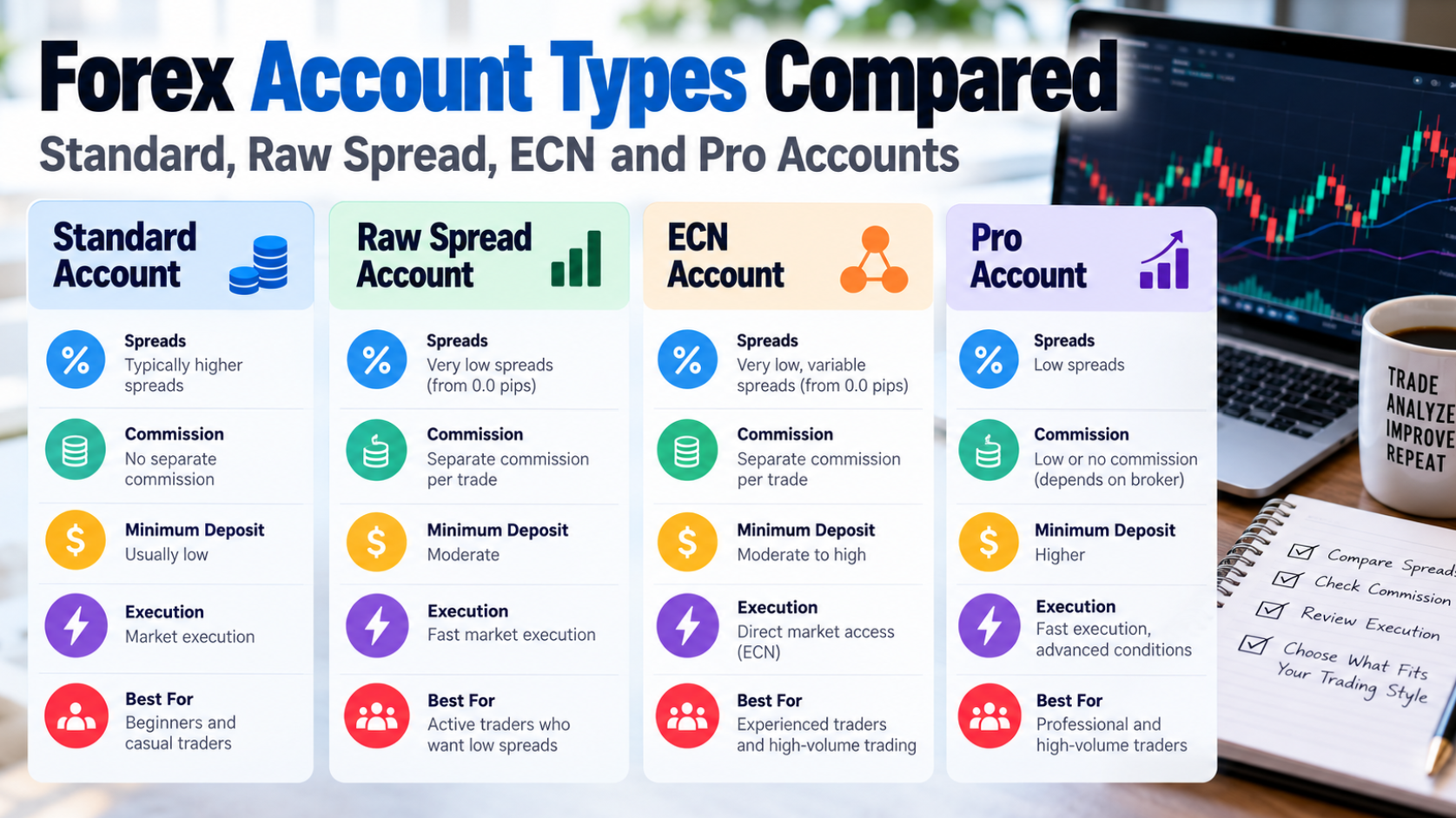
Forex account types help traders learn about the available options in order to make a right choice prior to making the initial deposit. Most often, brokers provide a selection of at least four forex accounts such as standard, raw spread, ECN and professional.
The main differences are related to spreads, commission, minimal deposit, execution method and trading conditions. In general, for instance, the beginner trader would probably like to use a rather simple account without the separate trading commission, whereas an active trader would need lower spreads.
This article describes the main features of the available accounts, makes a comparison of costs and answers the question what forex account should I choose.
What Are Forex Account Types?
Forex trading accounts allow one to trade the foreign exchange market using the trading platform of a broker. Forex trading accounts dictate the cost of transactions, charges, and trading conditions.
Despite brokers offering different names for their forex trading accounts, there are four common types that include the standard account, raw spread account, ECN account, and pro account. It is important to compare different forex trading accounts side by side.
Here is a quick overview:
| Account type | Typical spread structure | Commission structure | Suitable for |
| Standard | Usually wider | Often included in the spread | Beginners and casual traders |
| Raw spread | Often close to market pricing | Usually charged separately | Active and cost-conscious traders |
| ECN | Often very tight | Usually charged separately | Traders seeking market access and competitive pricing |
| Pro | Depends on the broker | Varies by account terms | Experienced or eligible high-volume traders |
These are general characteristics, not universal rules. Some brokers use the term ECN for accounts that do not provide genuine direct access to an electronic communication network. Always check the broker’s actual execution model and fee schedule.
1. Standard Forex Account: Simple and Accessible
The conventional forex account is usually designed for traders who prefer simple pricing terms without having to pay a separate commission fee on each transaction.
Instead of a commission, the broker usually uses the spread in order to reward itself.
Spread refers to the difference between the bid and ask price of the currency pair.
Let us suppose that the spread of EUR/USD is 1.2 pips. While opening a trade, a trader initially incurs the price cost based on the spread, but the total cost will depend upon the size of the position and other charges as well.
Advantages of a Standard Account
- Straightforward pricing: Traders can estimate spread costs without adding a separate per-trade commission.
- Beginner-friendly structure: The fee arrangement is often easier to understand.
- Flexible access: Many brokers offer relatively accessible minimum deposits.
- Suitable for occasional trading: Traders who place fewer orders may appreciate the simpler fee structure.
Potential Drawbacks
The only drawback is that the spreads may be higher than those on raw spreads. This may become significant for traders who open and close their positions often.
Nevertheless, the usual account is not necessarily more expensive. Its total cost will depend on the actual spread at the moment of trade, as well as on the conditions set by the broker.
For a beginner in currency trading, a regular forex account can become a quite realistic choice, especially if the broker is properly licensed.
2. Raw Spread Forex Account: Lower Spreads With Commission
A normal spread account usually provides spreads that are nearer to the market prices of the broker. It depends upon the market situation, as during volatile situations or liquidity problems, the spreads can be higher. In case of major currency pairs, the spreads can be near zero.
The broker levies separate commissions for trade execution. Therefore, spread cannot give a complete cost perspective.
Advantages of Raw Spread Accounts
- Tighter spreads may reduce trading costs.
- Pricing can benefit traders who execute many transactions.
- The separate commission makes part of the cost structure visible.
- The format may suit scalping and short-term trading strategies.
Disadvantages to Consider
Commissions must be included when calculating the total expense of a trade. Traders should also check whether the advertised minimum spread is typical or merely the best possible figure.
A raw spread forex account may be attractive to active traders, but its suitability depends on the broker’s commission schedule, execution quality and actual spreads during the trader’s preferred sessions.
3. ECN Forex Account: Understanding the Execution Model
A forex account described as an ECN (Electronic Communication Network) connects market participants through electronic systems that facilitate order matching. Depending on the broker and its network, participants may include banks, liquidity providers, brokers, and other market participants. For more insights into forex brokers and trading platforms, visit Broker Review Pro.
ECN is commonly found in marketing efforts by brokers, and therefore it is important to understand its definition in that particular account agreement. Just because an account has ECN attached to it does not guarantee direct access to any particular network..
Key Characteristics of ECN Accounts
Typically, ECN-type accounts provide tight spreads and commissions separately. Additionally, they may feature variable rates based on market liquidity.
Many traders appreciate such a system because it allows to see clearly the spread and commission components. Execution time, slip, order execution remain broker-dependent.
Whom Is This for?
For experienced traders who know about variable spreads and commission rate system, an ECN forex account is a good choice. Also, if you trade frequently with the help of specific strategies, an ECN account might work for you, but only under proper trading conditions.
4. Pro Forex Trading Account: Built for Experienced Traders
A pro forex trading account typically targets experienced traders, eligible clients or customers who trade larger volumes. Nevertheless, there is no single industry-wide definition of a pro account.
One broker might use the term for an account with reduced commissions, while another may require a minimum balance, higher trading volume or professional-client eligibility.
Common Features

A pro forex trading account may include:
- Negotiated or reduced trading commissions.
- Competitive spreads and execution conditions.
- Higher available trading limits, subject to broker rules.
- Access to dedicated support or additional trading tools.
- Eligibility requirements that differ from standard retail accounts.
These benefits are not guaranteed. Some professional-client classifications also involve reduced regulatory protections, depending on the jurisdiction.
For this reason, traders should not upgrade simply because an account carries the word “professional.” Review the minimum requirements, fees, leverage conditions and consumer protections before making a decision.
Forex Account Types Compared: The Main Differences
The most useful way to compare accounts is to look beyond their names. The differences between forex trading account structures can affect both everyday costs and how comfortably a trader manages positions.
Spread and Commissions
Standard accounts usually include broker commissions within overall spreads. The raw spread and ECN accounts provide tight spreads along with separate commissions. The pro account can have either one.
In case of forex account commissions, it’s necessary to consider the full cost of transaction opening and closing rather than spread only.
Minimum Deposit
There is a wide variation of minimum deposit requirements. While some brokers accept small minimum deposit amounts, specialized accounts may require more capital or active trading experience.
The minimum deposit amount does not indicate any quality of execution and safety of transactions.
Execution and Slippage
Slippage means the deviation of transaction execution from the requested price level. It is possible due to volatile market or announcement period.
Account types cannot ensure good execution quality. It’s important to analyze order policies and trading conditions first.
Trading Instruments and Leverage
Accounts come with different trading instruments, margins or leverage ratios. This may affect the utility of an account in executing one’s strategy.
Recall that leverage increases both profits and losses. An inexpensive account does not make leveraged forex trading any safer.
Raw Spread vs Standard Account: Which Is Cheaper?
The raw spread vs standard account comparison depends on the spread and commission charged for a particular trade.
Consider an illustrative example using EUR/USD and a position of one standard lot, where one pip is worth approximately $10.
- Standard account: 1.2-pip spread and no separate commission.
- Raw spread account: 0.2-pip spread and a $7 round-turn commission.
The cost of the spread for the standard account will be around $12, whereas the cost of the spread plus the commission cost for the raw account will be around $9.
It is just an example; actual figures will differ from broker to broker, depending upon currency pairs used, market situation, and lot sizes. Other fees apart from financing fees and slippage are not considered.
ECN vs Standard Account: What Should Traders Know?
The choice between an ECN and standard account is not just about cost but also concerns execution conditions and the experience of the trader.
While a standard account could have simpler costs, it will make it easier for occasional traders to understand their expenses. An ECN-like account could offer smaller spreads and commissions separately which could be helpful for active traders.
Nevertheless, an either way does not ensure good fills or smaller costs in all cases. Traders need to look into execution policies of the broker, their pricing history if there is any, their commission schedule and regulatory background.
The best approach here would be to choose what works for you without extra costs and complications.
How to Choose the Right Forex Account

If you are wondering which forex account should I choose, begin with your trading habits rather than the account’s marketing claims.
Beginners: A standard account may be easier to understand because its pricing is relatively straightforward. Consider practising with a demo account before risking real money.
Scalpers and active traders: A raw spread account may be worth comparing if tight spreads and frequent trades are important to your strategy. Include all commissions in your calculations.
Experienced market participants: An ECN-style account may be suitable if its execution model, pricing and available instruments match your needs.
High-volume or eligible clients: A pro forex trading account may provide competitive conditions, but verify its eligibility criteria and whether professional classification affects your protections.
Before deciding, check regulation, deposit and withdrawal policies, minimum trade sizes, overnight financing, inactivity fees and customer support. Comparing these forex account types using the same currency pair and position size will produce a more meaningful result than comparing account names alone.
Common Mistakes to Avoid
Traders, even the most experienced, can miss some essential points during the process of account creation.
First of all, do not think that the absence of spreads automatically leads to zero costs of trading. Commissions and other fees can exist.
Secondly, do not pick up brokers that offer extremely high leverage, as it can only lead to larger losses faster.
Thirdly, make sure that you know the legal entity where your account will be opened, since the broker’s name can refer to another legal company.
At last, keep in mind that forex trading is a highly risky financial operation. Pick up an account according to its affordability and ability to manage your losses.
Conclusion
The key distinctions between standard, raw spread, ECN and pro accounts are about pricing, commissions, order execution and suitability of each type. All these formats have certain advantages; however, none is guaranteed to be the best one for all traders.
The standard account might be easy for novices in terms of cost issues, while raw spread or ECN-like account will suit those traders who analyze both spreads and commissions in detail. Pro accounts will allow to provide individual conditions to suitable clients, although such conditions and protections require careful study.
Spend enough time on comparing the real costs of trading, finding out the regulation of the broker and testing the platform before any money depositing.
FAQs
1. Which forex account is best for beginners?
A standard account is often easier for beginners to understand because commissions are commonly included in the spread.
2. Is a raw spread account cheaper?
It can be, particularly for active traders, but total costs depend on spreads, commissions and execution.
3. What is the difference between ECN and standard accounts?
ECN-style accounts typically use tighter spreads and separate commissions, while standard accounts commonly incorporate charges into the spread.
4. What is a pro forex account?
It is an account intended for experienced or eligible traders, potentially offering specialised pricing or trading conditions.
5. Can I change my forex account type later?
Many brokers allow account upgrades or changes, subject to their terms, eligibility requirements and account policies.